How We Source Our Power Shutdown Data


If you’re relying on this site to know whether your power is going out today, you deserve to know exactly where that information comes from and how much you can trust it. So here’s the honest, detailed version — not a vague “we update daily” line, but the actual process behind every listing you see on this site.
It starts with TANGEDCO’s own circulars, not anything we generate
Every day, TANGEDCO’s local sections and substations across Tamil Nadu issue maintenance circulars. These are official documents listing exactly what’s scheduled — which substation or feeder is involved, the areas and streets that fall under it, the date, the start and end time, and the reason for the work, whether that’s transformer servicing, feeder maintenance, line repair, or something else.
This is the same process TANGEDCO has followed for years, long before this website existed. Local section offices plan their maintenance work, and the circular is how they communicate it — both internally to their own field teams and, in theory, to the public. The problem has never been that this information doesn’t exist. It’s that it’s published in a scattered, document-heavy way that’s genuinely hard for an ordinary person to check quickly.
We don’t create this data. We don’t estimate what’s likely to happen based on past patterns. We don’t fill in gaps with guesses about which areas “probably” have maintenance today. Every single listing on this site traces back to an actual circular that TANGEDCO published.
What our process actually looks like, day to day
We check for new circulars every day, across all 38 districts. Since different TANGEDCO sections publish on slightly different schedules — some early morning, some the evening before for the next day — this isn’t a single “refresh at 6 AM and done” process. It’s closer to continuous monitoring throughout the day, updating each district as new circulars come in for that area.
Once a circular is available, we go through it and pull out the specific details: the district, the substation or feeder name, the list of affected areas and streets, the scheduled time window, and the stated reason for the shutdown. We organize this into the searchable format you see on the site — by district, by area, and by today/tomorrow — so that instead of opening a PDF and scanning through a long list, you can just type your area name and get your answer in a few seconds.
This is genuinely just a compilation and presentation process. The underlying facts — which area, what time, why — are TANGEDCO’s, not ours. What we’re adding is the searchability and the “check this in ten seconds instead of ten minutes” part.
What “no shutdown announced” actually means
This is worth explaining clearly, because it’s easy to misread. When a district card on our site says something like “no shutdown announced today,” that’s a direct reflection of what we found in TANGEDCO’s published circulars as of our last update — it means no maintenance has been listed for that district. It does not mean we checked and assumed everything was probably fine. There’s a real difference between those two things, and we think that difference matters if you’re actually depending on this information.
The flip side of this is also true: if a circular hasn’t been published yet for a particular section — which does happen, especially earlier in the day before that day’s schedule is fully out — we simply won’t have anything to show for that area yet, rather than guessing. This is why you’ll sometimes see a district update later in the day, once its circular finally comes through.
Why timestamps matter more than people usually realize
Every district card carries an “updated X hours ago” (or minutes ago) label. We think this is one of the more important parts of how this site works, because “when was this checked” is genuinely as important as “what does it say.”
Here’s why: TANGEDCO circulars aren’t all published at the same moment. A district whose circular came out at 6 AM and one whose circular is only released by evening are in very different situations if you’re checking at, say, 9 AM. Without a timestamp, both would just look the same — a static list with no indication of freshness. With the timestamp, you can immediately tell whether you’re looking at genuinely current information or something that might update further later in the day.
What this data does and doesn’t cover
This is a limitation we think is important to be upfront about. This site tracks planned, scheduled maintenance shutdowns only — the kind TANGEDCO announces in advance through circulars. It does not track:
Unplanned outages caused by equipment faults, storm damage, tripped breakers, or technical failures. These happen without advance notice, by definition, so there’s no circular to pull this information from in the first place.
Highly localized issues specific to a single building, connection, or transformer that aren’t part of a broader area-wide circular.
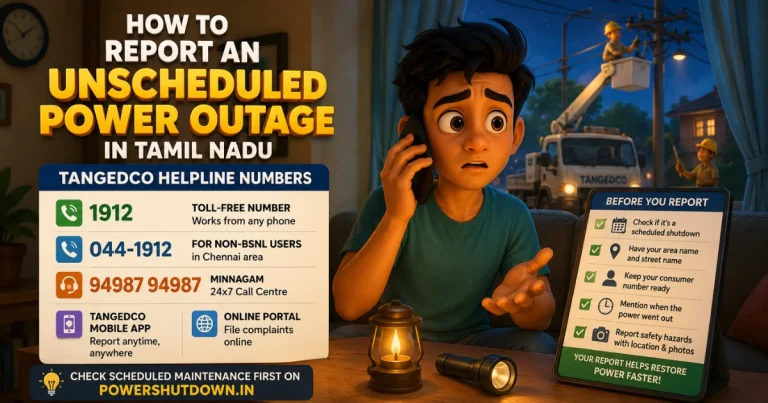
If your power goes out and your area isn’t listed anywhere on this site, the most likely explanation is that you’re dealing with one of these unplanned situations, not a gap in our data. In that case, the right move is to report it directly to TANGEDCO — through their 1912 helpline, the Minnagam call centre, or their mobile app — since that’s a different process entirely from checking a maintenance schedule.
How reliable is the timing, really
We’d rather be honest about this than oversell it. Most scheduled shutdowns fall between 9:00 AM and 4:00 PM, and in our experience tracking these circulars daily, power is often restored on time or a bit earlier if the work finishes ahead of schedule. But delays do happen — bad weather can slow down outdoor repair work, and sometimes a crew finds an issue mid-repair that takes longer than planned to fix. The scheduled time window reflects TANGEDCO’s plan, and it’s a genuinely useful guide, but it isn’t a guarantee down to the minute. No source publishing this kind of maintenance data claims that level of precision, including TANGEDCO’s own circulars.
Similarly, for tomorrow’s schedule specifically: since it’s published a day in advance, there’s a slightly higher chance of a revision or cancellation between when the circular comes out and the actual day, usually due to weather or a shift in priorities. Today’s schedule, being closer in time, has very little room left to change by comparison.
Why we’re explaining all this instead of just saying “trust us”
Honestly, because we think a page telling you your power might go out deserves to explain itself properly. It’s easy for any website to slap “Live Updates” on a badge and leave it at that. We’d rather you understand exactly what’s behind the numbers you’re looking at — where they come from, how fresh they are, and what they don’t cover — so that when you check this site before planning your day, you’re making that decision with the full picture, not just a green checkmark you’re hoping is accurate.
If you ever come across a listing that doesn’t match what’s actually happening in your area, or a shutdown that isn’t reflected here, we genuinely want to know — reach out through our Contact page. This entire site only works if the underlying data stays accurate, and that depends partly on people telling us when something looks off.
Related Posts