
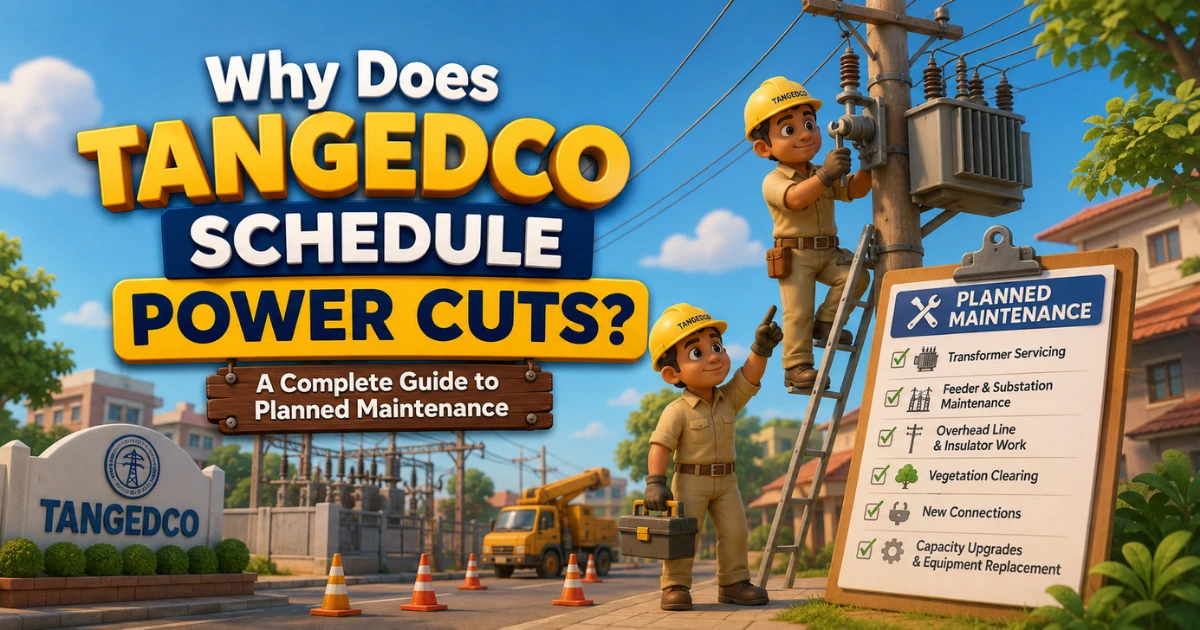
If you’ve ever seen a shutdown listed for your area and thought “but everything was working fine, why turn it off,” you’re not alone. Planned power cuts can feel unnecessary from the outside, especially when nothing seemed broken beforehand. But there’s a fairly logical system behind why TANGEDCO does this, and once you understand it, the whole thing makes a lot more sense — and honestly, it starts to feel less like an inconvenience and more like something working the way it’s supposed to.
Here’s what’s actually going on behind those shutdown circulars.
The basic idea: fixing things before they break, not after
Electrical infrastructure doesn’t fail all at once. Transformers develop wear over years. Insulators on overhead lines degrade slowly from weather exposure. Circuit breakers accumulate small faults that don’t show up until they cause a bigger one. If TANGEDCO only ever responded after something failed, every fault would be an emergency — unpredictable, often affecting more people than necessary, and taking longer to fix because nobody saw it coming.
Planned maintenance flips that model. Instead of waiting for a transformer to fail during peak load on a hot afternoon, engineers inspect it on a scheduled basis, catch problems early, and fix them during a controlled window when they can safely de-energize the line, work on it properly, and restore power once it’s done. It’s the same logic as servicing a vehicle before it breaks down on the highway, except the vehicle here is a segment of the state’s electrical grid.
What actually happens during a shutdown
A single maintenance circular can cover a range of different work, and it’s not always the same thing every time. Some of the most common reasons you’ll see listed:
Transformer inspection and servicing — Distribution transformers need periodic checks: oil levels, insulation condition, connections. This is routine, but it can’t be done live, so the transformer needs to be temporarily taken off the network.
Feeder and substation maintenance — The feeder lines that carry power from a substation out to your area need inspection too, along with the switching and protection equipment inside the substation itself. Faulty protection equipment is actually one of the more dangerous things to leave unchecked, since it’s what’s supposed to isolate a fault quickly if one occurs.
Overhead line and insulator work — Insulators are the components that keep high-voltage lines safely separated from the poles carrying them. Over time, especially with weather exposure, they can crack or degrade. Replacing them, along with general line repair, is a common reason for a shutdown.
Vegetation clearing near lines — Tree branches growing into high-tension lines are a genuine safety hazard, and trimming them safely requires the line to be de-energized first. This tends to spike seasonally, particularly before monsoon, when overgrown branches near power lines become a bigger risk during storms.
New connections — When a new consumer needs to be connected to an existing feeder, that feeder often needs to be briefly de-energized to safely make the connection. This is a smaller, more localized reason, but it does show up regularly in circulars, especially in growing residential areas.
Capacity upgrades and equipment replacement — As demand grows in an area, TANGEDCO sometimes needs to upgrade aging equipment or add capacity to handle the load. This kind of work tends to be less frequent but can mean a longer shutdown window than routine maintenance.
Why some areas get shutdowns more often than others
This is a question we hear a lot, and it’s a fair one — if you’ve noticed your area seems to show up on the maintenance list more than a friend’s area across town, there’s usually a real reason, not randomness.
The biggest factor is the age and condition of local infrastructure. Older parts of a city, or areas that were connected to the grid decades ago, tend to have transformers, feeders, and lines that are simply due for more frequent inspection and replacement work. Newer developments, especially ones built with underground cabling instead of overhead lines, tend to need far less frequent maintenance, since underground cables are less exposed to weather and vegetation-related damage.
Industrial or high-load areas can also see more scheduled work, since heavier and more constant load puts more stress on transformers and equipment, which means shorter intervals between necessary checks.
None of this means an area is being “targeted” or treated unfairly — it’s really just a reflection of what’s due for servicing on that particular section’s maintenance calendar.
Why 9 AM to 4 PM, and why restoration times vary
Most shutdown circulars specify a window somewhere in the 9 AM to 4 PM range, and this isn’t arbitrary. It’s generally chosen because it avoids the very early morning and evening hours when household power needs tend to be highest, while still giving crews enough daylight hours to complete the work safely.
Within that window, though, the actual restoration time can shift a bit in either direction. If a crew finishes the scheduled work early, TANGEDCO typically restores power right away rather than waiting until the announced end time — there’s no reason to keep an area without power once the job’s done. On the other hand, if something unexpected turns up mid-repair, or the weather makes outdoor work slower, the restoration can run a little past the scheduled time. This is fairly normal for any maintenance-based system: the schedule reflects the plan, not a guarantee down to the minute.
Why doesn’t TANGEDCO just do all this work at night, when fewer people would notice?
It’s a reasonable question, and the short answer is safety. A lot of this maintenance — climbing poles, working on live equipment sections, replacing insulators — is genuinely dangerous work, and doing it in daylight with proper visibility is a basic safety requirement for the linesmen and engineers doing it. Emergency fault repairs do happen at night when necessary (TANGEDCO does run dedicated night crews for exactly this reason in cities like Chennai), but planned, non-urgent maintenance is scheduled during the day specifically because it’s safer for the people doing the work.
How this connects to fewer unplanned outages overall
It’s worth stepping back and looking at the bigger picture here. The entire point of scheduled maintenance is to reduce how often you experience an unplanned outage — the kind that happens with zero warning, often at the worst possible time, and takes longer to fix because a crew has to first figure out what went wrong before they can even start repairing it.
A transformer that’s regularly inspected is far less likely to fail catastrophically during peak summer demand. A feeder with well-maintained insulators is less likely to trip during a storm. Vegetation cleared away from lines ahead of monsoon season means fewer branches falling onto wires during heavy wind. In other words, the two-to-seven-hour planned shutdown you see on a circular today is very often the reason you don’t experience a much longer, much less predictable outage a few weeks or months down the line.
That doesn’t make a scheduled cut any less inconvenient in the moment, especially if it lands on a day you needed uninterrupted power. But understanding it as prevention rather than just disruption does change how it feels.
What you can actually do with this information
Since these shutdowns are planned and published in advance, the practical value is knowing about them before they happen rather than after. That’s really the whole reason a page like this one exists — TANGEDCO does publish this information daily through its section circulars, but it’s scattered enough that most people only find out when the power’s already off.
Checking your district or area on PowerShutdown.in takes a few seconds and tells you whether today or tomorrow has anything scheduled, what time window it falls in, and which substation or feeder is involved. If you know a shutdown is coming, charging your devices the night before, filling water tanks ahead of time, and planning around it becomes simple. If your area isn’t listed at all, and your power still goes out, that’s a good sign you’re dealing with an unplanned fault instead — which is a different situation entirely, and one worth reporting through TANGEDCO’s complaint channels rather than just waiting it out.
Either way, the shutdowns themselves aren’t random inconvenience — they’re the routine upkeep that keeps the lights on reliably the rest of the time.